







Cash register for the beauty industry – a guide for owners
December 1, 2024
Cash register – how to operate it?
February 8, 2025
Fiscal printers - model comparison
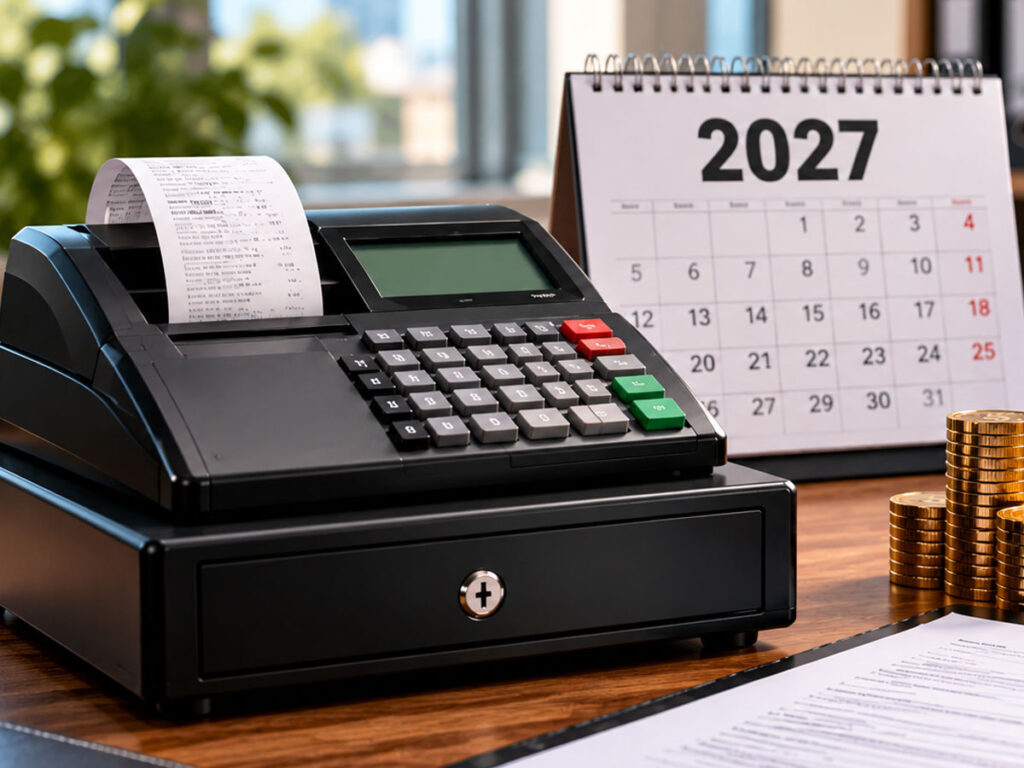
Fiscal printers are a fundamental piece of equipment for professional retail, service, and catering establishments, ensuring compliance with applicable regulations and seamless customer service. Choosing the right model isn't just about price. Equally important is matching the device to the nature of the business, the number of transactions, the size of the product range, and the operating conditions. Implementing the right fiscal printer can streamline sales processes within your company. Read our comparison of fiscal printers to help you choose the right equipment for your industry.

What are fiscal printers?
A fiscal printer is a device that records sales, prints receipts, and confirms transactions in accordance with the requirements of national tax law. Unlike cash registers, printers do not operate independently; they require connection to a sales system, such as a computer, POS terminal, or tablet equipped with the appropriate software. This software is a key element controlling the operation of the fiscal printer. The device itself serves as the "printing finalizer" of transactions, but the operating logic, management of the product database, prices, tax rates, and reporting are provided by the sales system.
Fiscal printers are increasingly integrating seamlessly with modern sales and warehouse management software, enabling the monitoring of large product volumes, handling multiple payment methods, and remotely updating prices. At the same time, to meet the growing needs of businesses, manufacturers offer a wide range of models—from simple, compact mobile versions to devices designed for use in large supermarkets or high-traffic bakeries. Detailed information on available solutions can be found, among others. here.
What types of fiscal printers do we distinguish?
When choosing a fiscal printer, you should consider not only price and hardware specifications, but above all the specifics of your business. The main criteria are:
- Mobility or stationarity of the device,
- Estimated sales load (number of transactions, number of prints),
- Communication options (LAN, Wi-Fi, Bluetooth, USB),
- Print width and capacity of the product database,
- Compatibility with software and work environment.
Have questions? Ask our expert!
Mobile printers for small retail outlets and islands
If you run a small service point, a seasonal stand, or a small kiosk on a shopping mall island, a lightweight and handy mobile printer will be a perfect choice. A perfect example is the Posnet Temo Online, a compact device designed for relatively small workloads. Similarly, the Posnet Trio Online works well in conjunction with a tablet, ideal for workstations with limited space. Novitus also offers an interesting range, for example:. Novitus Deon Online, which defines mobility as an important differentiator.
Mobile printers usually have a smaller product base and a simpler design, but they are sufficient where the product range is limited and the daily number of receipts does not exceed several dozen or several hundred pieces.

Desktop printer models with a smaller product base

For locations that are a bit more established but still have a relatively low transaction load, you can consider stationary models offered in lower price ranges, such as Fawag BOX.
This device doesn't have Wi-Fi, and its product base is relatively small, making it more suitable for small stores with limited and infrequently updated inventory. The lack of wireless connectivity won't be a problem for many businesses, provided the printer operates at a fixed point of sale directly connected to a computer or terminal.
Mid-Segment Printers – Flexibility and Greater Efficiency
When a company needs a more efficient solution and the product range is expanding, it's worth considering mid-range fiscal printer models. These printers often offer a choice of different displays, communication interfaces, and a larger product database. An example is the family of devices Postnet Thermal XL2 Online.
These models are ideal for medium-sized retail outlets, where the number of transactions and product diversity are increasing and businesses need a stable and more extensive sales infrastructure. These printers can be scaled as the business grows, without requiring an immediate investment in high-end equipment.

Heavy-duty devices. Printers that are extremely durable and reliable.
Industries with extreme workloads, such as large grocery stores, hypermarkets, non-stop bakeries, and industrial plants, require top-of-the-line printers with exceptional durability and low failure rates. Here, it's worth considering models like Posnet Thermal HD Online, Novitus HD 2 Online, NovitusPoint Whether Postnet Thermal HX Online.


According to available data, some of these devices have an exceptionally low failure rate – with intensive use, the rate can be as low as a fraction of a percent. This means the risk of sales downtime is minimal. For large bakeries serving hundreds of customers daily, a printer failure during peak hours is a catastrophic scenario. Therefore, heavy-duty models represent an investment in process stability and the assurance that the device will not fail even with a very large number of receipts.
Network communication and software integration
It's worth noting that in the age of widespread digitalization, connectivity and printer integration with various software are key. Mobile models often feature Bluetooth or Wi-Fi, making them easier to use in smaller locations where infrastructure is limited. Stationary, more advanced printers can support a wide range of interfaces, including USB, LAN, and RS-232, ensuring a stable connection with sales and warehousing systems.
When choosing a fiscal printer, it's worth considering not only the hardware specifications but also the software capabilities, which determine the device's actual functionality. A well-chosen system will allow for quick price updates, efficient reporting, and integration with other elements of the store's infrastructure, ensuring stable and trouble-free operation.
Fiscal printer - what to consider when choosing a device
The choice of a fiscal printer should be based on a thorough analysis of the needs of a given point of sale. Mobile fiscal printers are suitable for small, often portable stations or retail islands. Basic stationary models are a good start for small businesses with a limited product range. As the number of products, customers, and transaction complexity grows, it's worth considering more advanced devices with flexible configurations. Meanwhile, businesses with large-scale operations, high transaction frequency, and extreme workloads should consider heavy-duty equipment characterized by durability and reliability.
It's crucial to properly match the printer to the specific needs of your business, taking into account both current needs and future growth prospects. This way, investing in new equipment will translate into efficiency, effectiveness, and greater customer and service satisfaction.
Additionally, it's worth remembering that the fiscal market and tax settlement regulations are constantly evolving. Choosing a printer that allows for flexible adaptation to regulatory changes will ensure not only full compliance with applicable standards but also readiness for future challenges. This way, your investment will remain profitable and relevant to market requirements, and your company will gain a competitive advantage in the long term.
If you are looking for a high-quality fiscal printer that will meet the challenges of your business, contact us with us. We will select a device tailored to your challenges.