







First cash register – how to choose?
January 14, 2024
All-in-one cash registers – why are they worth it?
March 18, 2024
Payment card terminals - it's not complicated
Under current law, businesses are required to enable their customers to make cashless payments "using a payment instrument." In practice, the most convenient and popular method of meeting these requirements is through payment card terminals. Having them benefits both the company and its customers. This stems from the fact that card payments are convenient and secure, and a POS terminal allows for the expansion of offerings with additional services. Furthermore, it can also be operated mobile, which is useful not only for restaurants, but also for businesses conducting off-premises sales.

What are payment terminals?
To present the benefits of having a payment terminal to entrepreneurs, it's worth explaining what it is first., payment terminal, or POS (Point of Sale), is an electronic device that allows you to accept card payments (debit or credit), but not only that. The terminal also supports other forms of cashless payments, including mobile payments made via phone, watch, or BLIK. It's also worth emphasizing that accepting payments isn't the only functionality of a payment terminal. It also allows you to top up your phone (prepaid) and use the cashback service, which involves withdrawing cash when making card payments. As a result, a company with a POS terminal can expand its offerings with additional services, thus attracting new customers.
The benefits don't end there, however. Having a payment terminal can also improve service (e.g., by eliminating the hassle of giving change) and increase security, which results from keeping less cash at the register. From the customer's perspective, convenience and the ability to pay with international cards are crucial. Accepting cashless payments allows a company to increase sales. This is confirmed by research and statistics showing that customers who pay by card spend over 20% more than those who pay cash.
Have questions? Ask our expert!
How does a payment card terminal work?
One of the key advantages of payment card terminals is the convenience of making payments. How does a POS work in practice? The terminal reads information from the card (or phone, watch, etc.) using a magnetic, chip, or contactless (NFC) reader. It then connects to the payment service provider (PSP) or the customer's bank to obtain authorization for the transaction. The PSP or bank then checks the availability of funds in the customer's account, the card's validity, and other issues that may prevent the transaction. Once approved, the terminal notifies the merchant and the customer and prints a receipt confirming the transaction. The funds are transferred from the customer's account to the account of the company where the purchase was made.
What types of terminals are there?
Knowing what payment card terminals are and how they work, it's worth discussing their types. POS terminals are classified based on their mode of operation, which allows us to distinguish three main types of devices. These are:
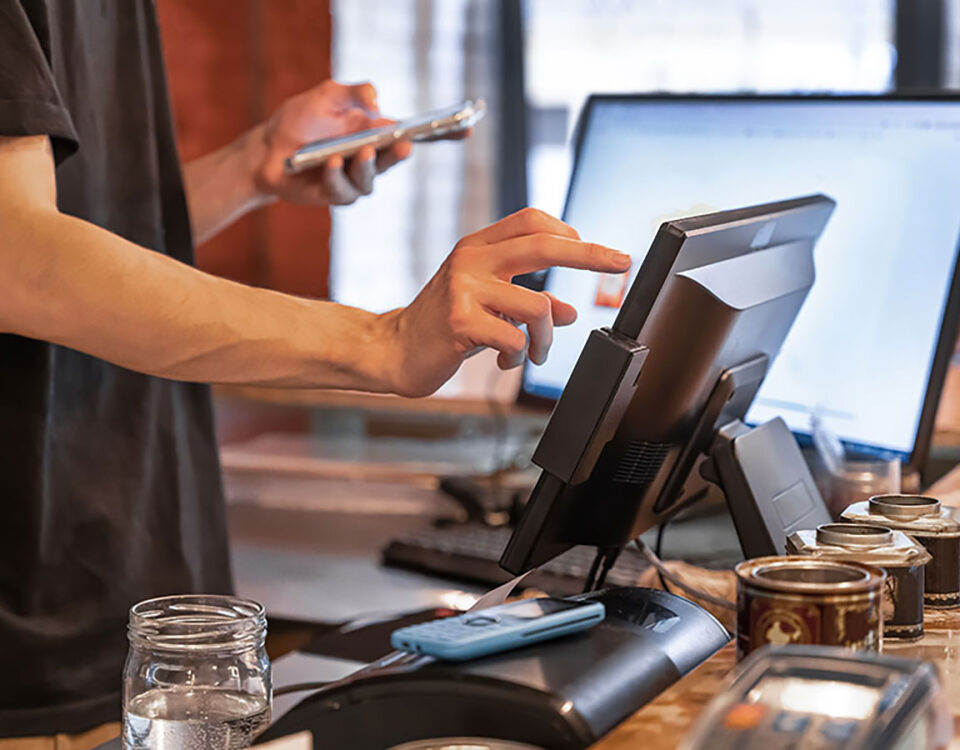
- Stationary terminals, or the most traditional devices, are permanently placed in one location, such as a counter. They connect via wires to both the internet and the electrical grid, requiring a constant power supply;
- Mobile terminals, i.e., portable devices that can operate within a specific area, for example, a company building. They are powered by a built-in battery and connect to the internet via Wi-Fi or Bluetooth;
- PinPads, i.e. devices with their own keyboard that are integrated with the cash register system, can operate independently or be connected to a stationary terminal.
At this point it is also worth mentioning the so-called. cash register terminals, This is a functional device that combines the capabilities of a fiscal device, a POS terminal, and sales software. Its advantages include not only functionality but also ease of use and low operating costs, resulting from the fact that there is no need to invest in several separate technologies.
What should you consider when choosing a terminal?
When choosing a payment terminal for your business, it's important to consider the company's needs and the specifics of your industry. Specific devices differ in many ways, including processor quality, general parameters, operation, and additional options. So how do you choose a payment terminal? For large stores offering a wide range of products and processing numerous transactions, it's worth choosing a terminal equipped with a fast processor, which will significantly improve customer service. The device will not only be able to quickly connect to the cash register but also handle various promotions, customer applications, and loyalty programs. A less advanced device, on the other hand, will be suitable for businesses that accept cashless payments less frequently. Examples include hairdressing and beauty salons, where device speed, and therefore processor performance, is less important.
What else should you consider when choosing a terminal? The location where payments will be accepted is a key consideration. Many businesses conduct sales outside of their company's premises. Examples include sales representatives and couriers, for whom a mobile terminal is ideal. Therefore, when choosing one, it's worth considering the quality and capacity of the built-in battery. Another important consideration is the terminal's functionality, as some devices also enable additional solutions, such as prepaid top-ups or cash withdrawals. This is particularly useful for smaller stores, which can increase their profits this way. It's also worth remembering that there are also terminals that can work with specific types of cash registers. An example is the terminal. Postnet NetPay, i.e. a device compatible with Fawag Lite Online 2.01, Revo Online 1.01 and Neo Online 1.01 cash registers.
Integration of the POS terminal with cash register and sales systems
Payment card terminals are devices that simplify payment processing and increase payment security. They also eliminate the risk of errors when accepting payments, which is possible thanks to the integration of the POS with an online cash register or sales system. As a result, information about the transaction amount is automatically transferred to the terminal, eliminating the need to manually enter it. This is a convenient solution that is ideal for various industries (e.g., grocery stores, gas stations, pharmacies, and many other locations). The benefits are not limited to reducing the risk of errors when accepting payments and improving customer service. They also save space at the checkout. Not having to have a printer in addition to the terminal also allows for optimized printing costs.
Having a payment card terminal in your company not only allows you to fulfill your obligation to provide your customers with the option of making cashless payments, but as you can see, it also brings many tangible benefits. Centrumkas.pl offers not only high-quality POS terminals but also professional advice and technical support. Simply contact us, tell us about your business and the type of cash register you have, and we'll select the right terminal for you.