







Cash register for gastronomy
May 24, 2026
You're closing your business - what to do with your cash register?
July 19, 2026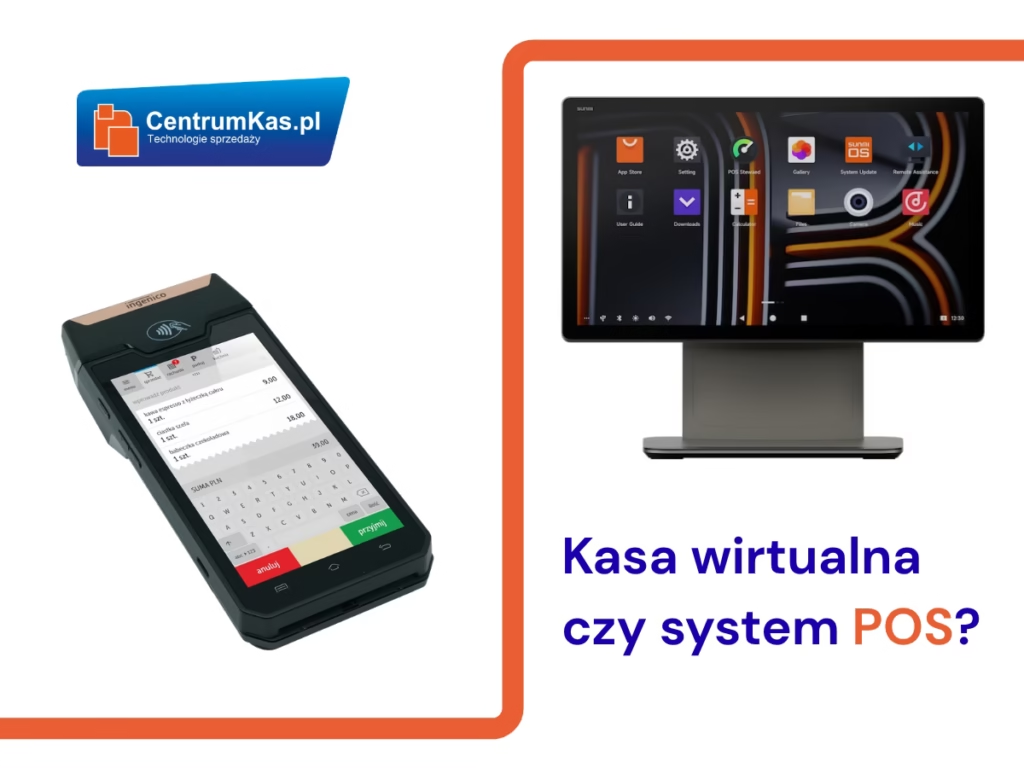
Virtual cash register or POS system?
A comprehensive comparison of costs, functionalities, and company development opportunities
Virtual cash register or POS - this is one of the most important dilemmas in gastronomy and trade. Just a few years ago, most entrepreneurs opted for traditional online cash registers. Today, the market looks completely different. Companies increasingly expect not only sales to be recorded in cash registers but also workflow automation, order control, and convenient personnel management.
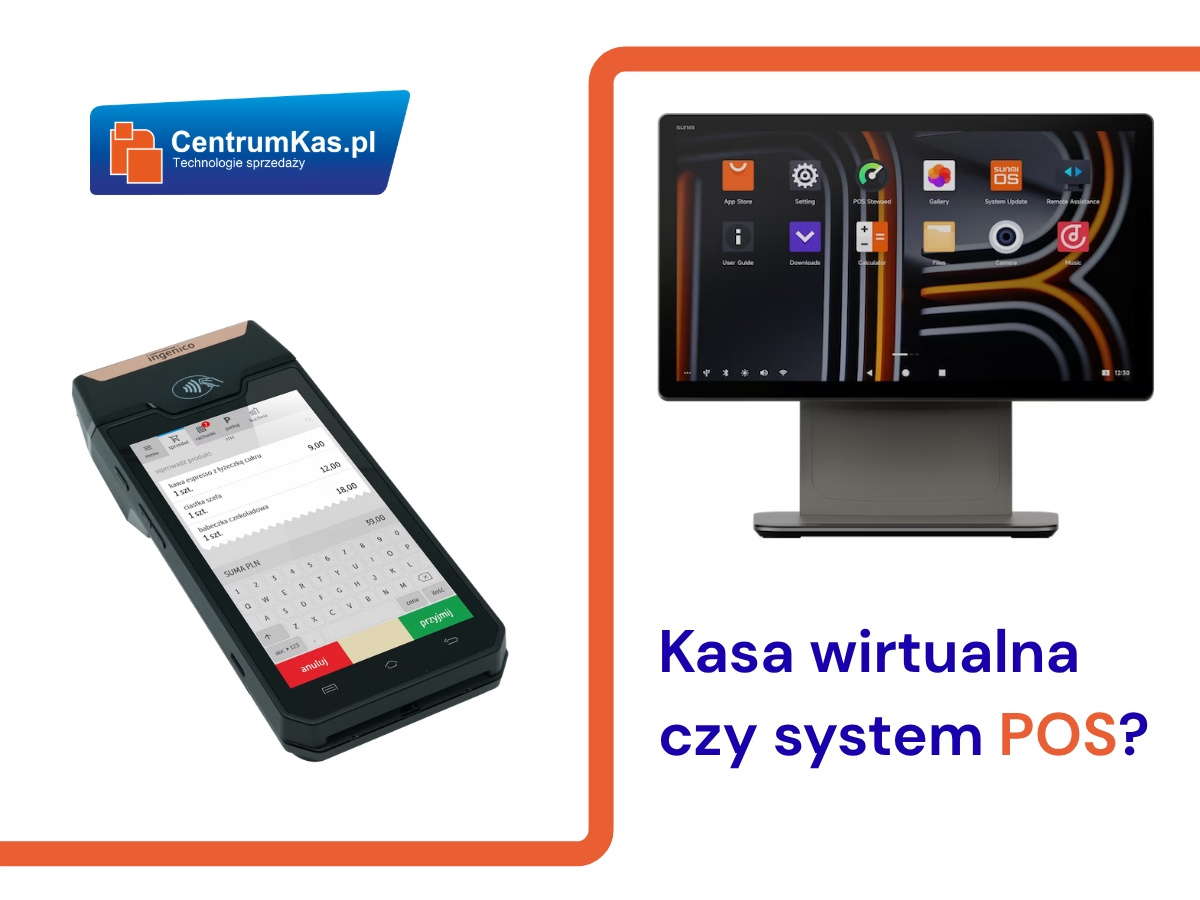
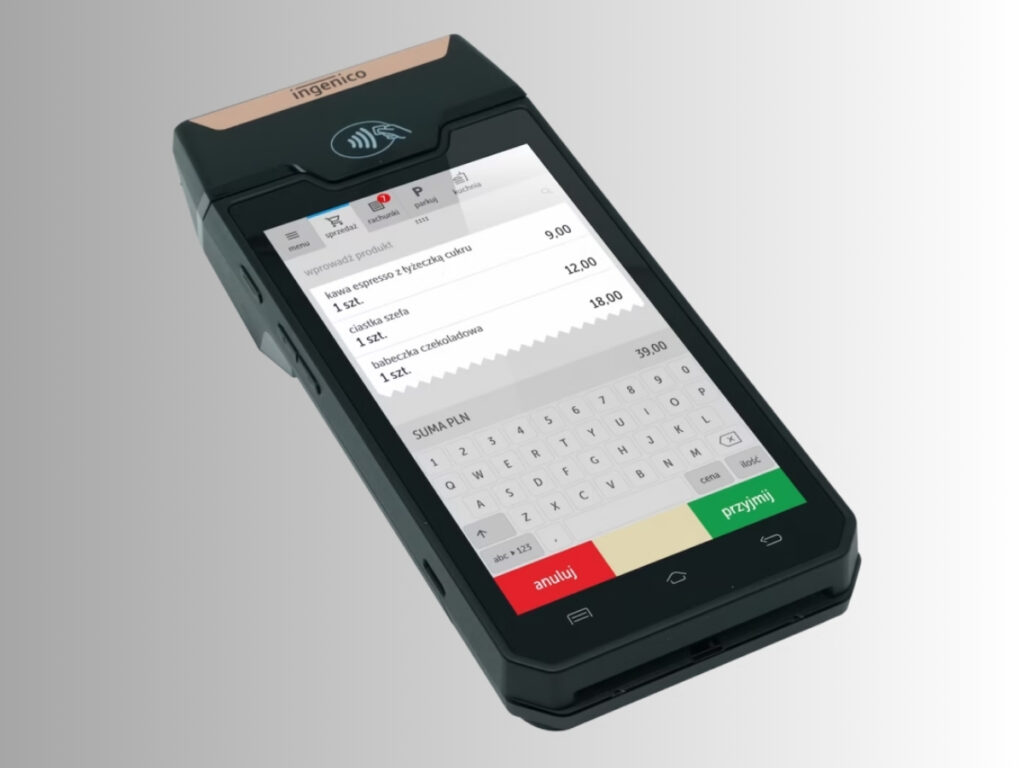
At first glance, a virtual cash register seems like a much cheaper solution. In many cases, it actually helps reduce startup costs. It's a fiscal app that's installed on a dedicated Android device. That's why many small businesses start with this type of solution.
On the other hand, POS systems, available from companies such as CentrumKas.pl, are gaining popularity. Solutions like Dotykačka POS aren't limited to issuing receipts. They allow for management of virtually the entire establishment—from orders, through the kitchen, to the warehouse, sales reports, and delivery.
In practice, the difference between a virtual cash register and a POS system is much greater than the device price or subscription fee. These are two completely different approaches to sales and workflow.
What is the difference between a virtual cash register and a POS system?
Virtual cash register This is primarily an application used for sales fiscalization. It typically runs on dedicated Android-based mobile devices or payment terminals. Its primary function is to issue receipts in accordance with the requirements of the Ministry of Finance.
This solution works well where sales are simple, mobile, or small-scale. This is why virtual checkouts are popular in food trucks, mobile services, and outdoor events, among other applications.
POS system It operates much more broadly. It's a complete environment for managing sales and organizing the operations of a restaurant. A modern POS can handle sales, inventory, orders, waitstaff, communication with the kitchen, payments, reports, analytics, delivery, and loyalty programs.
In practice, a POS system often becomes the operational center of a company. In a restaurant or café, it's responsible not only for sales but also for the flow of information between the dining room, the kitchen, and the owner. This allows businesses to respond more quickly to problems and more effectively manage daily operations.
Virtual cash register vs. POS - functionality comparison
| Function | Virtual cash register | POS system |
|---|---|---|
| Sales fiscalization | Yes | Yes |
| Warehouse service | Limited | Expanded |
| Many positions | Limited | Full service |
| KDS kitchen system | Most often, there is no | Yes |
| Sales reports | Basic | Advanced |
| Personnel management | Limited | Extensive |
| Delivery integrations | Limited | Wide |
| Loyalty programs | Rarely | Yes |
| System expansion | Limited | Very large |
| Scaling the business | More difficult | Very good |
| Own fiscal module | Lack | Yes |
Have questions? Ask our expert!
Why does virtual cash register seem cheaper?
The biggest advantage of virtual cash registers remains their low entry cost. Businesses often don't need to purchase expensive hardware. This means that starting a business costs significantly less than building a full POS station.
This is a huge advantage, especially for new businesses looking to reduce startup costs. This allows you to start selling almost immediately, without investing thousands of zlotys in a full-fledged POS station.
Mobility is also important. Virtual cash registers work very well:
- in food trucks,
- during events where catering services are offered,
- in passenger transport - e.g. taxi,
- in the catering industry,
- in small catering outlets.
For example, a food truck owner can conduct sales solely via a terminal or tablet. They don't need a large checkout counter, a kitchen printer, or a large warehouse. This is why virtual checkouts remain a very attractive solution for small businesses.
Have questions? Ask our expert!
Hidden costs and risks of virtual cash registers
However, a low startup cost doesn't mean risk-free. This is one of the most important aspects that is often overlooked in simplistic comparisons. With virtual checkouts, much of the technical responsibility is transferred to the user.
The entrepreneur is responsible, among other things, for:
- correct operation of the device,
- Android system up to date,
- internet stability,
- device security,
- application configuration,
- updates,
- battery status of your phone or tablet.
In practice, this means a significantly higher risk of problems during daily operations. A phone update can cause app errors. An employee might accidentally close the app or change device settings. This is particularly problematic in the restaurant industry, where speed of service is paramount. Even a brief downtime can cause organizational chaos and customer dissatisfaction.
It's also worth remembering that many companies use employee or owner-owned devices. This further increases the risk of technical issues and data security issues.
An example from gastronomy
Imagine a small restaurant operating solely on a tablet with a virtual cash register. The restaurant is operating at full capacity on a Friday evening. Suddenly, the tablet freezes after an automatic Android update.
Waiters lose the ability to issue receipts. The kitchen is unable to receive some orders. Staff begin writing down orders by hand, and the queue of customers grows.
With a professional POS system, the risk of such problems is significantly lower. The system runs on dedicated hardware designed for continuous operation. Furthermore, many elements can be duplicated or backed up in the event of an emergency.
This is why larger catering establishments very rarely base all their sales solely on simple virtual cash registers.
The POS system offers more than just sales
The biggest advantage of a POS system isn't fiscalization itself. The key factors are the workflow and expansion capabilities.
Modern POS systems can be expanded practically as a business grows. Initially, a business owner might use a single point of sale. However, over time, additional elements can be added:
- additional positions,
- kitchen printers,
- payment terminals,
- waiter applications,
- customer displays,
- warehouse,
- delivery integrations,
- reporting,
- loyalty systems.
- KDS displays (for kitchens)
- Possibility of installing a kiosk or self-service checkout.
This means that the business owner doesn't have to replace the entire system as the business grows. They can simply add additional modules gradually. This is a huge advantage over a simple virtual cash register.
A POS system also works well in multi-station locations. When multiple people are taking orders simultaneously, the system can automatically synchronize sales, inventory, and reports. As a result, the owner gains greater control over the business.
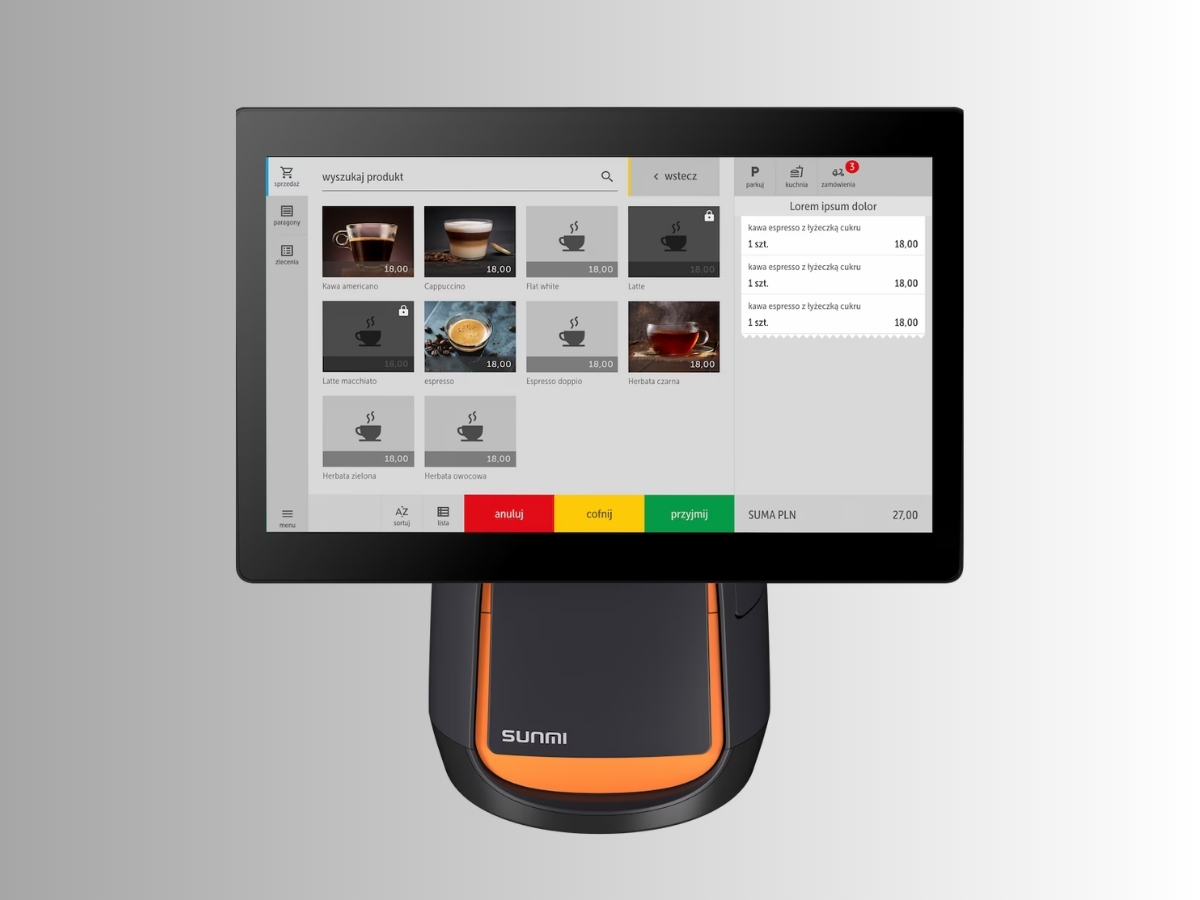
KDS - a feature that changes the organization of restaurant work
One of the most important elements of a modern POS is the KDS, or Kitchen Display System. This system of kitchen screens displays orders in real time. This eliminates the need for the kitchen to work with paper coupons.
The benefits are significant. The restaurant reduces errors, speeds up communication, and improves workflow. Chefs see orders immediately after they are taken by the waiter. Additionally, the system can display order processing times and priorities.
For example, a waiter takes an order at a table and immediately sends it to the kitchen via a POS terminal. The chef sees the order on the screen, along with the delivery time. When the dish is ready, the system can automatically notify the server.
In the case of virtual cash registers, such functionalities are most often not available or their functionality is very limited.
Cost Comparison - 1 Year, 2 Years, and 5 Years
| Solution | 1 year | 2 years | 5 years |
|---|---|---|---|
| Virtual cash register | 1500–2500 PLN | 3000–5000 PLN | 7,500–14,000 PLN |
| Basic POS | 5000–7000 PLN | 7,000–10,000 PLN | 10,000–19,000 PLN |
At first glance, virtual cash almost always wins on price. The startup costs are low, and entrepreneurs often don't invest in extensive infrastructure.
For example, a basic solution based on a virtual cash register can cost around PLN 1,500–2,500 per year. A full POS system with a sales terminal, fiscal printer, and implementation can cost around PLN 5,000–7,000 in the first year.
Over the next few years, however, the cost difference begins to look different. Workplace ergonomics, speed of service, and the potential for further company growth are becoming increasingly important.
In practice, entrepreneurs often start with a simple solution and then invest in a POS after a few or more months of operation. This means double implementation, a change in workflow, and additional costs.
Why are many establishments switching from virtual cash registers to POS?
This is a very common scenario in the restaurant industry. At the beginning of a business, a virtual cash register seems ideal. It's inexpensive, quick to implement, and highly mobile. In a small restaurant, it's often completely sufficient.
However, problems arise as the number of customers and employees increases. This is when entrepreneurs begin to experience:
- lack of convenient multi-station work,
- organizational chaos,
- kitchen communication problems,
- limited reporting,
- lack of warehouse control,
- difficulties in handling delivery,
- limited work ergonomics.
As a result, the company begins looking for a more professional solution. This often ends with the implementation of a full POS system.
This is why many restaurants and cafes today treat virtual cash registers as a temporary or supplementary solution, rather than their primary sales system. Virtual cash registers can complement POS systems – when sales are conducted at the POS, fiscalization can be performed at the virtual cash register.
Additionally, the efficiency of the POS system accelerates the process of fulfilling all types of orders, which, even on a daily basis, can be of great importance in terms of the company's revenues and its further development.
When will a virtual cash register be a good choice?
Virtual cash registers remain a very good solution for many industries, especially when low entry costs and mobility are paramount.
This is a good choice for, among others:
- food trucks,
- small catering outlets,
- field services,
- sole proprietorship.
A virtual cash register can also work well for sole proprietorships, where sales are handled solely by the owner. In such cases, the risk of organizational problems is significantly lower.
When is it better to choose a POS system?
A POS system is best suited for businesses planning to expand and scale sales. This applies primarily to restaurants, cafes, pubs, confectioneries, bakeries, and delivery services.
POS allows you to streamline your workflow from the very beginning. Furthermore, businesses can gradually expand their workstations without having to replace the entire system.
This is a huge advantage over the course of several years of running a business. The owner doesn't have to adjust their workflow as the number of clients increases. The system grows with the company.
Additionally, modern POS systems offer extensive sales reports, staff work control, and analytics that allow you to make better business decisions.
Summary
There's no single, perfect solution for all companies. Much depends on the type of business and development plans.
If a company needs a simple and mobile sales tool, a virtual cash register can be a very good choice. However, where workflow, speed of service, and expandability are key, a POS system proves to be a much more future-proof solution.
In practice, the difference between these solutions isn't just price. What the company will look like in one, two, and five years is far more important. Therefore, before choosing a device, it's worth analyzing not only the startup cost but also the future growth of the business, workflow, and the comfort of daily customer service.